Sunday, April 17, 2016

Mechanization

Mechanization is the shift from work being done by hand, to being done by machinery. This concept originated with Gutenberg and the invention of the Printing Press, which was the beginning of assembly line production, allowing for mass production and mechanical reproduction. This occurred during a time period called the Second Industrial Revolution.   

      
The Printing Press 
<https://socialchangecourse.files.wordpress.com/2014/09/hdf1969_18agrandesinventions_web1.jpg>

  
Assembly Lines
<https://upload.wikimedia.org/wikipedia/commons/2/29/Ford_assembly_line_-_1913.jpg>

Walter Benjamin was a German-Jewish literary critic, philosopher, social critic, translator, radio broadcaster and essayist. In his 1936 essay, "The Work of Art in the Age of Mechanical Reproduction," he criticized mass production for tarnishing the uniqueness and authenticity of art. He believed that reproduction destroys uniqueness and detaches the object from tradition. This affected the way that society viewed the art that was being mechanically reproduced. As Benjamin wrote in his essay, "the greater the decrease in social significance of an art form, the sharper the distinction between criticism and enjoyment by the public." Society was not receptive to art that they didn't feel was original, authentic or unique.

Mass Production of Art
<http://pagnes.weebly.com/uploads/2/9/1/4/2914797/8164144.jpg?422>


 Moulin Rouge (2001) is a movie that I have seen that takes place during the Second Industrial Revolution in 1890. The Moulin Rouge was a cabaret show where the people of Paris could move on from thoughts of war to the exciting thoughts of technological advancements. The movie contains a lot of singing and dancing, and displays the importance of culture in that time period.

Moulin Rouge
<http://www.thesaucysampler.com/wp-content/uploads/2012/11/moulin-rouge.jpg>

Mechanization and industrialization created a major social change. Work shifted from being done by man, to being done by machines, and eventually computers. People went from working outdoors on farms to indoors in factories, in large assembly lines. This was a difficult time as it was a large adjustment for society, but it was also a time of exciting technological advancements, and the potential for daily life to get easier. 

Technological Advancements
<http://www.techcrates.com/employee-tech-training/>


Citations

Benjamin, Walter. "The Work of Art in the Age of Mechanical Reproduction." 1936. 1-7. Print. 12 Apr. 2016. 

Grimes, Elin. "What Major Influence Did the Industrial Revolution Have on Art?" Quora. Quora, 29 Jan. 2014. Web. 12 Apr. 2016.

Vesna, Victoria. "Robotics pt.1." Youtube. Uconlineprogram. 15 Apr. 2012. Web. 12 Apr. 2016.

Vesna, Victoria. "Robotics pt.2." Youtube. Uconlineprogram. 15 Apr. 2012. Web. 12 Apr. 2016.

Wilson, Ariel. "Moulin Rouge." Prezi. 2016 Prezi, 18 Dec. 2014. Web. 12 Apr. 2016.


Sunday, April 10, 2016

Math & Art


 I found it very interesting to learn that although mathematics is often removed from the study of art, in actuality, math is what connects science and art. As Vesna explains in her lecture, math has been used in art since the ancient times of the Babylonians, when they would press symbols into tablets of unbaked clay with a stylus. Vesna also outlines the importance of math in art in the creation of iconic landmarks including the pyramids in Egypt. It would be impossible to create so many artistic masterpieces without the use of mathematics. I also gained insight on the evolution of the idea of perspective. As Leonardo Da Vinci writes, perspective is a rational demonstration by which experience confirms that the images of all things are transmitted to the eye by pyramidal lines. 

     I believe that the Vitruvian Man is a piece of art that epitomizes the collaboration of art and mathematics. Acclaimed artist, Leonardo Da Vinci and architect Vitruvius combine both of their skills in art and math to create  the ideal proportions of a man, fit inside a circle and a square. This is created through art, i.e. drawing and shading, as well as mathematical tools like geometry. 


        Along with Da Vinci, any artists use math in their creative work. M.C. Escher uses structures in plain and projective geometry to create unique pieces, the Mona Lisa uses the divine ratio, while Duccio is the first artist to attempt to create perceptions of depth in his paintings. 

       
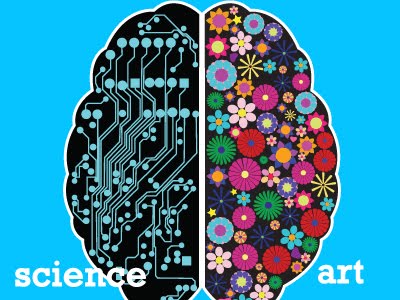
         The juxtaposition of math, art and science is that they all influence our perspective. Almost everything that we see in this world has been influenced by math, science or art. Math is what connects science and art. It is a common ground that scientists and artists have. Mathematics is crucial to both of their fields.  


Citations
Vesna, Victoria. “Mathematics.” Lecture. YouTube. Uconlineprogram. Web. 8 April. 2015. 
<https://www.youtube.com/watch?v=mMmq5B1LKDg>
Williams, Susan. "Proportion: DaVinci's 'Vitruvian Man'." Mathtivities. Web. 8 April. 2015. 
<http://www.math.afterschooltreats.com/wfdata/frame119-1019/pressrel2.asp>
Smith, B. Sidney. "The Mathematical Art of M.C. Escher." Platonic Realms Minitexts. Platonic Realms. Web. 8 April. 2015.
<http://platonicrealms.com/minitexts/Mathematical-Art-Of-M-C-Escher/>
Vesna, Victoria. "Math Intro"YouTube. Uconlineprogram. Web. 8 April. 2015.
<https://www.youtube.com/watch?v=eHiL9iskUWM>
Glydon, Natasha. "The Mathematics of Art." Math Central. Web. 8 April 2015. 
<http://mathcentral.uregina.ca/beyond/articles/Art/art1.html>

Sunday, April 3, 2016

Two Cultures

        In his lecture, C.P. Snow explains that while being educated in science, he is also a writer. He has friends in both fields, however the two groups don't interact.


         I have experienced this all my life being a high-level athlete who also values a healthy social life. I am on the Beach Volleyball Team at UCLA, and in fall quarter I rushed a sorority. It was very difficult to manage both, as the two parts of my life never coincided. I was either with my teammates, or with my sorority sisters, never both.


http://www.thesororitylife.com/newsDetail.aspx?id=53


        Where I have also experienced this idea of two cultures is being a Canadian going to school in the United States. In Canada, everything that I say is "so American", while in the States, everything I say is "so Canadian" It is when I say "eh" or annunciate the o too much in "sorry" that I get the weird looks and laughs from my American friends, while at home I am ridiculed when I use words such as "bomb" or "gnarly" to describe something cool.
http://www.diffen.com/difference/Canada_vs_United_States


        I am an undeclared freshman and I have taken classes in both art and science, so I have yet to experience the separation personally at UCLA, but all the time I hear about the separation between north and south campus. 


http://www.huffingtonpost.com/elaina-provencio/the-major-divide-humaniti_b_6582436.html


http://theconversation.com/why-arts-and-science-are-better-together-15004


        In "The Third Culture", John Brockman negates the idea that one day the two cultures, art and science, will communicate effectively. He believes that there is no need for this as there will be an emergence of a new culture. I disagree with Brockman and agree with Snow. It is very important for everyone should be acquainted with both cultures. They are both fascinating,creative, and make crucial contributions to our world. 


http://www.booksandculture.com/articles/2014/marapr/two-cultures-then-and-now.html


Citations

"Athletes are Sorority Women, Too." The Sorority Life. 2016 National Panhellenic Conference Office,  11 May. 2012.        

     Web. 1 April. 2016.
"Canada vs United States." Diffen.com. Diffen LLC, n.d. Web. 1 April 2016.
"The Major Divide: Humanities vs. STEM Majors." HuffPost College. TheHuffingtonPost.com, 2 March. 2015. Web. 1
"The Two Cultures, Then and Now." Books & Culture. 2016 Christianity Today, March/April 2014. Web. 1 April. 2016.
     April. 2016.
"Why arts and science are better together." The Conversation. The Conversation US, 24 June. 2013. Web. 1 April. 2016.